
Local SEO helps a Hyderabad small business show up in Google’s Local Pack (the map + 3 listings) and on Google Maps for “near me” searches. It works by fully optimizing your Google Business Profile, keeping your name/address/phone consistent everywhere online, and collecting reviews steadily. The same fundamentals — accurate, structured, consistent information — are now also what gets a business recommended by AI tools like ChatGPT, Google AI Overviews, and Perplexity, a practice known as GEO or AEO (Generative/Answer Engine Optimization).
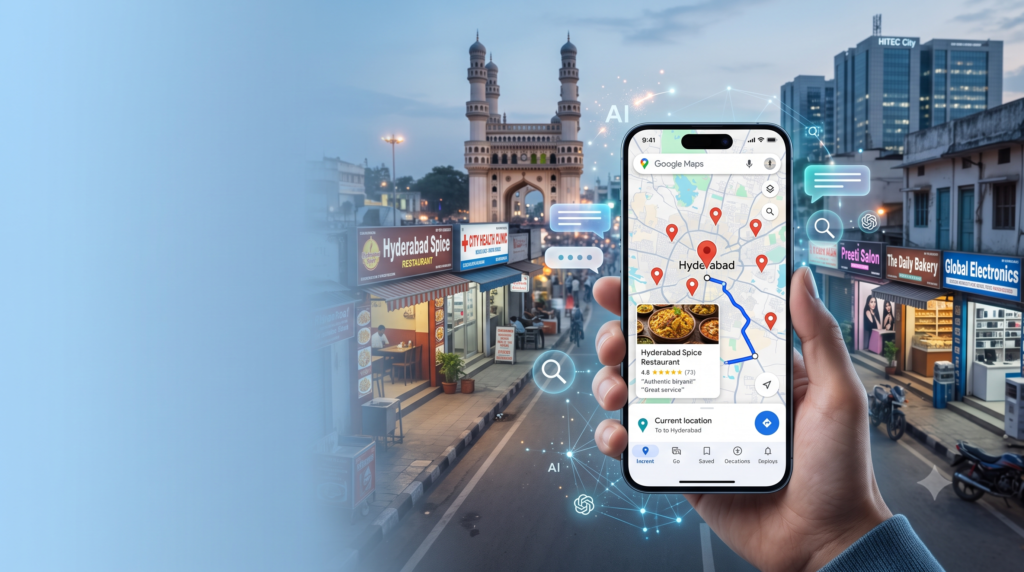
If someone near Banjara Hills searches “bakery near me” or asks an AI assistant “which AC repair service is good in Kukatpally,” the businesses that show up are decided by the same underlying signals — even though one is a map listing and the other is a generated answer. This guide covers both: how to rank in Google’s Local Pack, and how to make your business the one AI tools recommend.
What Is Local SEO, and Why Does It Matter More Than Regular SEO for SMBs?
Local SEO is the practice of optimizing your online presence so your business appears when people search for products or services near a specific location. Unlike broad organic SEO, it targets a much smaller, more relevant pool of competitors — the businesses actually near the searcher — which is why it tends to move faster and convert better for small businesses with a physical location or defined service area.
| Traditional Organic SEO | Local SEO (Maps / Local Pack) | GEO / AEO (AI Search Answers) | |
| Goal | Rank a webpage in the standard blue-link results | Rank your business in Google’s 3-Pack and Maps | Get cited or recommended in AI answers (ChatGPT, Perplexity, Google AI Overviews) |
| Where it shows up | Organic results page 1 | Map pack above organic results, Google Maps app | AI-generated summaries and chat responses, often with no visible ranking at all |
| Main signals | Content quality, backlinks, keywords, site authority | Google Business Profile completeness, reviews, NAP consistency, proximity | Clear, factual, well-structured content; consistent facts across the web; being quoted or cited elsewhere |
| Typical timeframe | 6-12+ months | 4-8 weeks for fundamentals to show movement | Ongoing — AI engines re-crawl and re-summarize frequently, so consistency matters more than a single push |
| Best for Hyderabad SMBs | Long-term brand visibility and content authority | Immediate calls, walk-ins, and directions from nearby customers | Being the business an AI assistant recommends when someone asks for a suggestion instead of typing a search |
How Does Google Decide Who Gets Into the Local Pack?
Google ranks local results using three core factors: relevance (how well your profile matches the search), distance (how close you are to the searcher), and prominence (how well-known and well-reviewed you are, both on Google and across the web). Distance is largely outside your control — relevance and prominence are where the actual optimization work happens.
Step 1: Fully Optimize Your Google Business Profile
Your Google Business Profile (GBP) is the single biggest lever in local SEO. Most Hyderabad SMBs have a profile but leave it half-filled — that gap alone is often the difference between showing up and not.
Get Your Category and NAP Right
Choose the most specific primary category available (“South Indian Restaurant” beats “Restaurant”), and add relevant secondary categories. Make sure your Name, Address, and Phone number (NAP) match exactly across your website, GBP, and every directory listing — small inconsistencies quietly hurt your prominence score, and they’re also what confuses AI tools trying to verify who you are.
Add Photos and Post Regularly
Profiles with recent, high-quality photos of the storefront, interior, team, and products get more clicks and calls than text-only listings. Google Posts (offers, updates, events) signal an active business — aim for at least one post every one to two weeks.
Turn Reviews Into an Ongoing System, Not a One-Time Ask
Review count, rating, and recency all factor into ranking — and detailed review text is increasingly what AI tools pull from when summarizing what a business is good at. Build a simple habit: ask every satisfied customer for a review at the natural end of their visit, and reply to every review within a few days.
Use the Q&A and Services Sections
Pre-fill the Q&A section with the questions customers actually ask (timings, parking, home delivery, pricing) instead of leaving it for strangers to fill in first. List services or products with clear, factual descriptions — this is exactly the kind of structured, specific text AI answer engines prefer to cite.
Step 2: Fix NAP Consistency Across Local Citations
Citations are mentions of your business name, address, and phone number on other sites — Justdial, Sulekha, IndiaMART, Practo, industry directories, and local Hyderabad listing sites. Google — and increasingly AI models — cross-check these against your GBP as a trust signal. Audit existing citations, fix mismatched details, and add your business to a handful of relevant, reputable directories rather than mass-submitting to low-quality ones.
Step 3: Support It With On-Page Local SEO
Your website should reinforce the same local signals:
- A dedicated, keyword-rich title tag and H1 that include your service + Hyderabad (or the specific locality you serve)
- An embedded Google Map and NAP details in the footer of every page
- LocalBusiness schema markup so both Google and AI crawlers can read your address, hours, and reviews programmatically
- If you serve multiple areas, individual location pages for each — not one generic “Areas We Serve” page
How Do I Optimize for AI Search Engines Like ChatGPT, Perplexity, and Google AI Overviews?
This is Generative Engine Optimization (GEO), also called Answer Engine Optimization (AEO) — making your business easy for AI tools to find, understand, and recommend. It builds directly on local SEO fundamentals rather than replacing them:
- Keep facts identical everywhere — name, address, phone, hours, and services should read the same on your site, GBP, and every directory; AI tools cross-reference sources and drop inconsistent ones
- Write definition-first content — answer the obvious question in the first 1-2 sentences of each section, the way this guide does, so it’s easy to extract as a standalone answer
- Add structured data (schema) — LocalBusiness, FAQPage, and HowTo schema give AI crawlers a clean, structured version of your facts instead of forcing them to infer from prose
- Earn mentions on third-party sites — local news, community blogs, and industry directories that mention your business by name build the same trust signal for AI tools that backlinks build for traditional SEO
- Keep review text detailed — a review that says “fixed my AC same day, fair pricing” is far more useful to an AI summarizer than a bare five-star rating
Common Mistakes Hyderabad Small Businesses Make
- Leaving the GBP category too generic or choosing the wrong one entirely
- Using a virtual office or unverifiable address, which risks suspension
- Ignoring negative reviews instead of responding professionally
- Inconsistent NAP details across the website, GBP, and directories
- Treating local SEO as a one-time setup instead of an ongoing habit
How Long Does It Take to See Results?
Most businesses that fix their GBP fundamentals and stay consistent with reviews and posts start seeing movement in the Local Pack within 4-8 weeks, with more competitive categories taking a little longer. AI/GEO visibility tends to follow a similar or slightly longer curve, since it depends partly on how quickly AI tools re-crawl and re-summarize the web. Consistency matters more than a single burst of activity in both cases.
The Data Behind This Guide
| What the Data Shows (2026) | Why It Matters for Hyderabad SMBs |
| Roughly half of all Google searches now carry local intent, and “near me” search volume in India has been growing well over 100% year-on-year. | Your local customers are searching this way constantly — the opportunity is large and still growing. |
| Local Pack (3-Pack) listings consistently out-click plain organic results for the same query, with combined click share across the top three spots often landing in the 40-55% range. | Ranking in the map pack usually beats ranking #1 organically for local, transaction-ready searches. |
| Businesses with a fully completed Google Business Profile — categories, photos, updated hours, review responses — see meaningfully higher click-through rates than businesses with incomplete profiles. | A half-filled GBP isn’t a placeholder — it’s actively losing you visibility against completed competitor profiles. |
| Zero-click searches and AI Overviews now account for a large and growing share of local queries, with AI assistants pulling business details from Business Profiles and structured, factual web content. | Showing up only in the Local Pack isn’t enough anymore — the same accurate, structured information needs to be citable by AI tools. |
| Most local-pack benchmarks put the minimum competitive review count at 10-20, with 50+ needed for competitive categories in major cities. | A slow, steady review habit is no longer optional — it’s a baseline requirement to be considered at all. |
Frequently Asked Questions
Do I need a physical address to rank in the Local Pack?
Yes — Google requires a real, verifiable location for most business categories. Service-area businesses without a public storefront can still qualify by hiding the address and defining a service area instead.
What’s the difference between local SEO and GEO/AEO?
Local SEO gets you into Google’s Map Pack and Maps results. GEO/AEO gets you mentioned or recommended inside AI-generated answers on tools like ChatGPT, Perplexity, and Google’s AI Overviews. They rely on overlapping fundamentals — accurate, consistent, well-structured information — so most of the same work supports both.
Can I do local SEO myself without an agency?
The basics — completing your GBP, requesting reviews, fixing NAP consistency — are very doable in-house. Where businesses usually need help is staying consistent over time, adding schema markup correctly, and adapting content for AI citation.
Getting Started
Local SEO and GEO/AEO both reward businesses that show up consistently and factually, not just the ones with the biggest budget. Start with your Google Business Profile this week — a complete category, five recent photos, and a plan to collect detailed reviews will move the needle faster than almost anything else on this list, in both Google Maps and AI search results.